Hybrid events without the awkwardness: lessons from a year of running them
Hybrid is harder than in-person and harder than virtual. It demands intentional choices that most events do not make.
Hybrid events are deceptively easy to half-do. You point a camera at the in-person event, stream it to remote viewers, and call it hybrid. That is two events held simultaneously, not a hybrid event.
A real hybrid event treats both audiences as full participants. The remote viewer should feel as engaged at the end of the program as the person who flew in to attend. That is hard, and after a year of running them, we have a small list of practices that consistently make the difference.
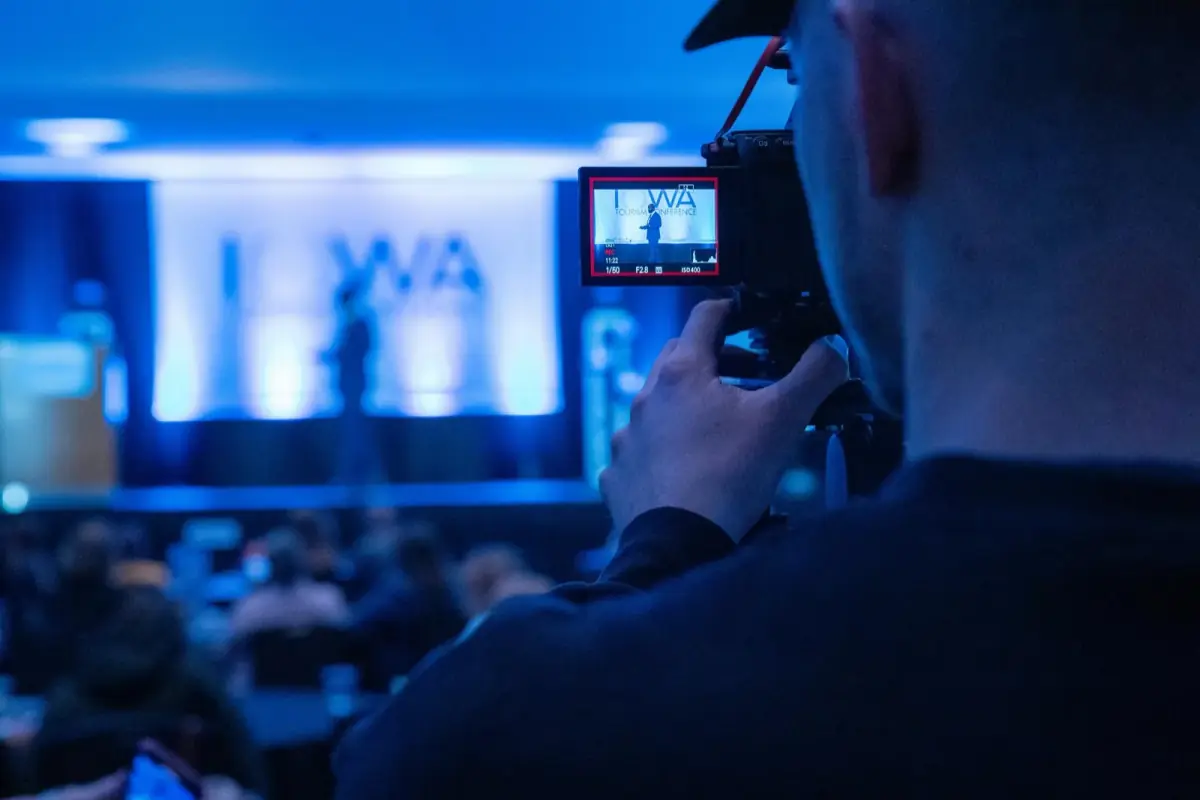
Treat the camera as an audience member
The camera operator's job is not to capture the event for the record. Their job is to represent the remote audience in the room. That means framing, timing, and pacing that match how a curious remote viewer would want to look at the action. It is closer to documentary filmmaking than to event coverage.
Practically, this means we brief operators on:
- What the audience cares about, which is the speaker's face during emotional moments and the slides during data moments
- When to push in, when to pull back, when to hold a wide shot
- What to do when a presenter goes off-script or interacts with the audience
A good multi-cam director can shape the remote viewer's experience as much as the speaker shapes the in-room audience's experience.
Build a remote producer role
Most hybrid events do not have a dedicated remote producer. They have a livestream technician who makes sure the stream is going out, and a program producer who runs the room. That is not enough.
The remote producer's job is to monitor the experience of the remote audience in real time. They are watching the stream on the actual platform, reading the chat, checking the audio levels at the encoder output, watching for buffering or quality drops. They are also empowered to interrupt the program if the remote audience is degrading — which sometimes means asking the MC to slow down, or to repeat a question for the camera.
This role costs the equivalent of one extra crew member. It is the single highest-ROI addition to a hybrid event budget.
Mix the audio for the stream, not the room
The audio that sounds great in a ballroom and the audio that sounds great on a stream are different. The room mix has natural reverb, audience reaction, and a wide dynamic range. The stream mix needs to be tighter, drier, more compressed, and louder relative to background.
We run two separate audio mixes for hybrid events: one to the speakers in the room, one to the encoder for the stream. They share a source but get processed differently. The cost of doing this is small. The improvement in the remote audience experience is large.
Acknowledge the remote audience
The biggest awkwardness in hybrid is when the in-person program never mentions the remote viewers. They feel like spectators at someone else's event. We always brief the MC to:
- Welcome the remote audience explicitly at the top of the show
- Take questions from the remote audience during Q&A, not just from the in-room crowd
- Refer to the remote audience by name or by chat handle when answering their questions
- Thank the remote audience at the end of the program
This is free, and it changes the entire feel of the event for the people watching from home.
Plan the breaks differently
In-person breaks are social time. Remote breaks are dead time, and many remote viewers will not come back from them. We solve this with bridge content — a host on camera, a pre-recorded sponsor segment, an interview with a participant — that runs during the in-person break.
It does not need to be elaborate. A friendly face on screen for fifteen minutes, talking about what is coming up next, is enough to hold a remote audience through a coffee break.
Test the failure cases
We rehearse hybrid events differently than in-person ones. The rehearsal asks: what happens if the stream drops? What happens if the encoder fails? What happens if a remote panelist's audio is bad? Each of those needs a documented recovery path, and the team needs to have practiced it.
The team that knows what to do when a panelist's audio fails will recover gracefully in under a minute. The team that does not know will spend five minutes on stage troubleshooting and lose the room and the remote audience at the same time.
Hybrid is harder. The work shows on screen. So does the lack of it.