Working with a venue's in-house AV: what to ask before signing
In-house AV is sometimes great and sometimes not, and the difference is decided by what you negotiate before signing the venue contract.
Every venue has a relationship with audiovisual production. Some venues run their own in-house AV team. Some have an exclusive partnership with an outside production company. Some allow any vendor to come in. The arrangement matters, and most clients only learn about it after signing the venue contract — at which point their options are constrained.
If your event matters, the AV arrangement should be a negotiated part of the venue contract, not an afterthought. Here are the five questions to ask before signing.
Is in-house AV included, optional, or mandatory?
Some venues include a basic AV package in the room rate. Some sell AV as an add-on. Some require that you use their in-house team for anything plugged into their building, with no exceptions. The difference matters for two reasons.
If in-house AV is mandatory and exclusive, you are committed to whatever they can do. If you have specific production needs the in-house team cannot meet, you are stuck — unless you negotiated an outside-vendor exception in the contract.
If in-house AV is optional, you can choose between using them and bringing in a production partner. That choice should be made based on the event's complexity, not on convenience.
We always recommend asking the venue's contract administrator to put the AV arrangement in writing before signing, even if it means delaying the contract.
What is the in-house team's actual scope?
"AV is included" can mean very different things. Some venues include:
- A simple PA and a wireless microphone
- A projector and a wired connection from a podium laptop
- Houselights you can dim
Others include:
- A full audio system with multiple wireless channels and a small mixer
- A staged set with backdrop and basic stage lighting
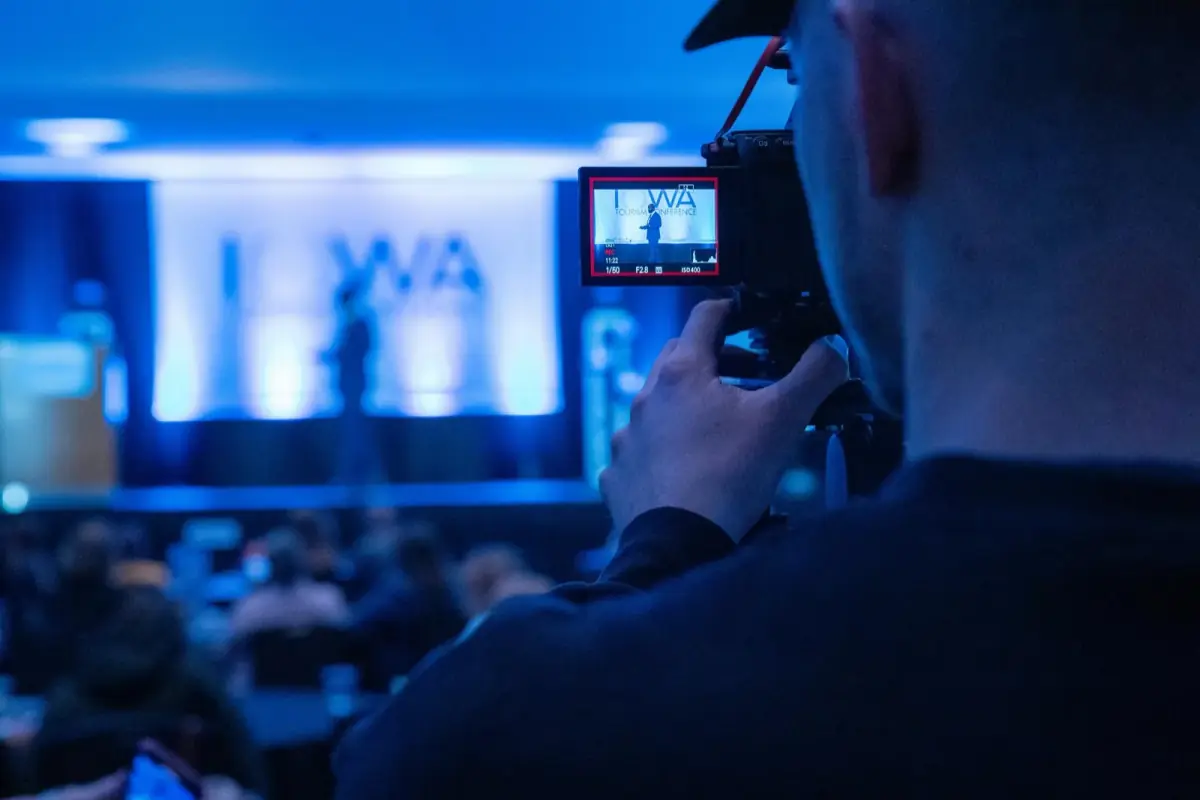
- Camera operators and a livestream encoder
- A production manager who runs the program
The first list is "the venue has a PA." The second list is "the venue has a production team." Confusing the two will hurt your event.
We always ask for a written scope of services that lists exactly what is included, what is extra-cost, and what is unavailable.
Who is the in-house technician on the day of your event?
In-house AV teams have widely varying skill levels. The lead engineer at a major hotel ballroom on a Saturday gala is usually excellent. The weekday-overnight tech who is on duty for a midweek breakfast event might be a part-time hire who has been on the job for two months.
We ask:
- Who specifically will be on duty for your event?
- What is their experience level?
- What is the escalation path if a problem occurs?
If the answer is vague, treat it as a flag.
What is the upgrade cost for the gear you actually need?
In-house AV inventories are sized for the venue's typical events. If your event is more complex than the typical — additional cameras, larger PA, more wireless channels, special lighting — the upgrade cost can be significant. Sometimes it is competitive with bringing in an outside team. Sometimes it is much higher.
We ask for the upgrade quote in advance, with specifics:
- Cost per additional wireless channel
- Cost per camera position
- Cost for a dedicated production manager
- Cost for any non-standard lighting fixtures
The numbers tell you whether the in-house route is economical.
Can you bring in supplemental gear or crew?
For complex events, you may want to use the venue's in-house AV for the basic infrastructure and bring in your own team for the parts that matter most. Some venues allow this freely. Some allow it with a "patch fee" — a per-channel cost to integrate outside gear with the in-house system. Some prohibit it entirely.
We always ask:
- Can we bring in our own cameras, microphones, or lighting fixtures?
- Is there a patch fee, and how is it calculated?
- Are there any prohibited items, like our own audio mixer or our own wireless frequencies?
The answers shape the production plan.
When in-house is the right answer
For straightforward events — single-room program, modest tech needs, no broadcast, no special lighting — the in-house team is often the right answer. They know the room, they own the gear, they handle the logistics. The economics usually favor them.
For complex events — multi-room programs, livestream, broadcast, sponsored brand activation, anything where the production is part of the experience — bringing in a production partner is usually worth the additional cost.
The decision should be a conversation between you, the venue's AV lead, and a production partner who can scope your event honestly. If any of the three is missing from the conversation, the decision is being made with incomplete information.